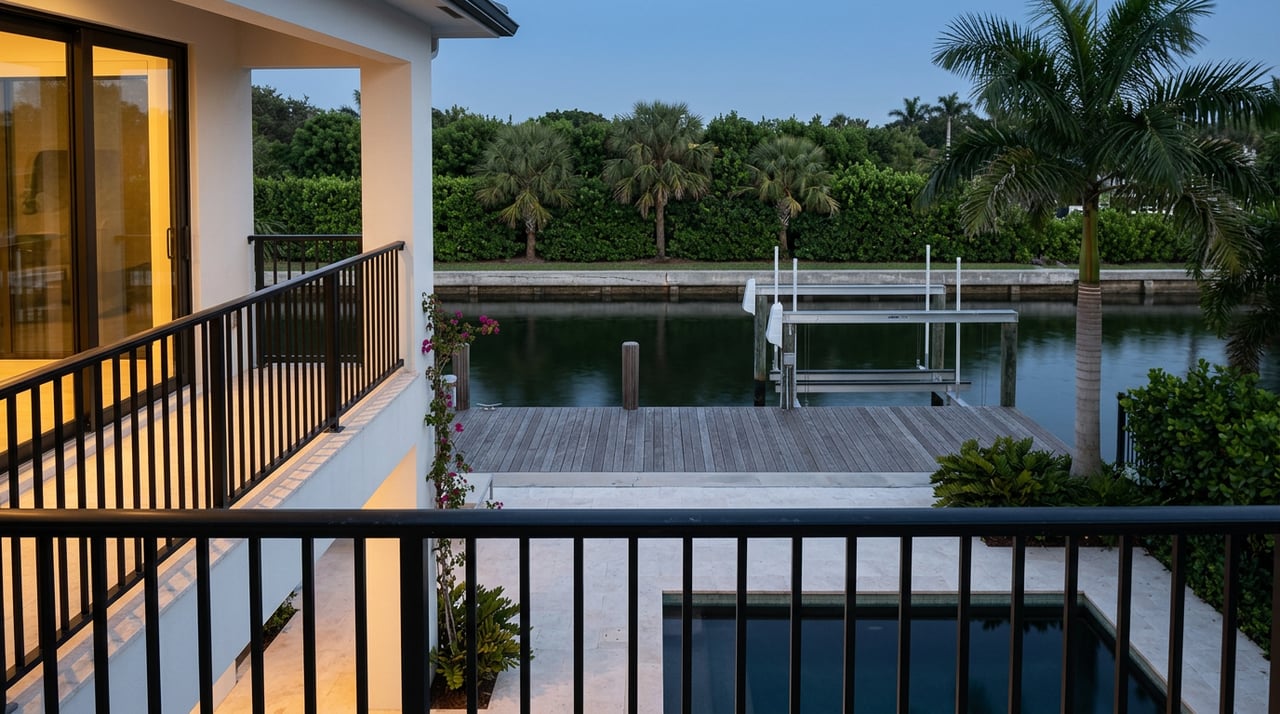
Harbour Inlet sits south of Seabreeze Boulevard, at the point where the Stranahan River meets the Atlantic and the neighborhood's roughly 100 homes look out across Port Everglades. That position means the last week of October reads differently here than it does anywhere else in Fort Lauderdale. The Fort Lauderdale International Boat Show doesn't set up inside the gate. It sets up a few hundred yards north, across the same inlet these homes are built to face, and a large share of the roughly 1,300 vessels that fill it arrive by water rather than by trailer.
That is the thing worth understanding before the show's 67th edition opens on October 28. The disruption most guides describe, parking, shuttle lines, ticket gates, happens on land at Bahia Mar and the Broward County Convention Center. For a neighborhood south of 17th Street facing the port those boats use to reach the show, the more relevant story is what moves past your dock in the days leading up to it, and what it takes to cross 17th Street once the show is running.
What changes on the water first
Before a single visitor walks through a turnstile, the show has to get its fleet in place. Organizers describe FLIBS as six miles of floating docks spread across seven venues, Bahia Mar Yachting Center, Las Olas Marina, Hall of Fame Marina, Pier Sixty-Six Marina, the Superyacht Village at Pier Sixty-Six South, the Broward County Convention Center, and the 17th Street Yacht Basin. Getting a fleet that size into position means a heavier-than-usual run of vessel traffic through Port Everglades in the days before opening, since that inlet is the most direct route from open water into Bahia Mar and the 17th Street Yacht Basin, the two venues closest to Harbour Inlet.
None of that traffic comes through the gate. It comes past it. For residents whose homes face the port rather than a public street, that is the more accurate way to think about show week than the parking-and-shuttle framing built for visitors driving in from Miami or Palm Beach.
What's actually new this year
Two details separate the 2026 show from prior years, and both are worth knowing regardless of whether you plan to attend.
Tickets are online only. For the first time, there is no box office on site. Every ticket is digital, scanned at entry, which means the walk-up crowd that used to gather near the gates buying same-day passes will not exist this year. Anyone attending, including a guest of yours, needs to buy in advance at flibs.com.
Las Olas Marina gets a floating pickleball court. New for 2026, the show is hosting a floating pickleball court at Las Olas Marina, with a tournament reserved for show crew. It is a small addition, but it says something about how far the show's footprint has grown beyond boats themselves, into an entertainment complex that now runs five full days rather than a weekend trade show.
The show's public hours for 2026 are set as follows:
| Day | Date | Hours |
|---|---|---|
| Preview Day | Wednesday, October 28 | 12 p.m. to 7 p.m. |
| Show Day | Thursday, October 29 | 10 a.m. to 7 p.m. |
| Show Day | Friday, October 30 | 10 a.m. to 7 p.m. |
| Show Day | Saturday, October 31 | 10 a.m. to 7 p.m. |
| Show Day | Sunday, November 1 | 10 a.m. to 5 p.m. |
Wednesday's preview day draws a noticeably smaller crowd than the weekend, which matters if you're planning to run an errand near Seabreeze Boulevard that week and would rather do it before Thursday.
The corridor that actually matters
Harbour Inlet's position south of 17th Street means any trip toward downtown, the beach, or the airport crosses that stretch of road, the same stretch Bahia Mar sits on and the same stretch the show's complimentary shuttle and golf cart loop uses to connect the Convention Center, Bahia Mar, and the Superyacht Village. That loop runs continuously, starting an hour before the show opens each day and continuing an hour after it closes, which stretches the window of added traffic well past the posted hours above.
This is the part a visitor's guide won't tell you, because a visitor only has to get to the show once. A resident crosses that corridor every day the show is running, often more than once, for reasons that have nothing to do with boats.
Moving without fighting the corridor
The same infrastructure built for out-of-town visitors turns out to be useful for residents who want to avoid driving through the thick of it. The show's own transportation network runs on Brightline, shuttle, and water taxi, in that order. A rider can take the Brightline express train into the Fort Lauderdale station, board the free Red Route shuttle to the Riverside Hotel on Las Olas, and then catch the water taxi straight to Bahia Mar. A single day of water taxi service runs fifteen dollars, and the same boats connect the Convention Center, Pier Sixty-Six Marina, and Las Olas Marina, with stops as far up the Intracoastal as Blue Moon Fish Co. and Shooters Waterfront. A Windward VIP ticket bundles that water taxi access in with the purchase.
None of that requires touching 17th Street by car. If you're headed toward downtown or Las Olas during show week and want to skip the shuttle loop entirely, the water taxi is doing the same job the show already built for its own visitors, just available to anyone with a ticket.
Why the show keeps expanding instead of shrinking
The show is owned by the Marine Industries Association of South Florida, an organization founded in 1961 that now represents more than 500 members across Broward, Miami-Dade, and Palm Beach counties and supports an estimated 142,000 jobs and $18.5 billion in regional economic output. FLIBS itself is credited with generating roughly $1.79 billion in economic output across Florida each year, including $709.7 million in direct sales by Florida companies and $85.8 million in state and local tax revenue, with $24.5 million of that landing in Broward County specifically.
Those figures explain why the show has stayed anchored to this stretch of Fort Lauderdale for 67 years and why it keeps adding to itself, a floating pickleball court this year, a fully digital ticketing system, rather than staying flat. For a neighborhood that sits this close to the show's center of gravity, that trajectory is worth knowing. This isn't a one-time event that might eventually move or shrink. It's a fixture that has grown every year it's been held here, and Harbour Inlet's position on Port Everglades means the neighborhood will keep feeling it on the water for as long as that's true.
A short list for the week itself
- Buy any tickets in advance. There's no box office this year, and a guest arriving without a digital ticket will be turned away at the gate.
- If you're headed off the peninsula during show hours, expect the shuttle loop to add time to any trip that crosses 17th Street, especially in the hour before opening and the hour after closing.
- Wednesday's preview day is the quietest window if you want to see the show without the weekend crowd.
- The water taxi network, not the shuttle loop, is the fastest way to reach downtown or Las Olas without driving through the corridor at all.
Living this close to the largest in-water boat show in the world means five days a year where the neighborhood's usual quiet gives way to something busier, both on the water and on the road that connects it to everything else. Knowing which one to plan around, and which one to simply enjoy from the dock, is the difference between a week that feels like an inconvenience and one that feels like the reason you live where you do.
If you're weighing what a home along this stretch of Port Everglades is actually like to own, week in and week out, Tim Singer has spent more than three decades working these blocks of Fort Lauderdale and can walk you through it. View Homes for Sale.