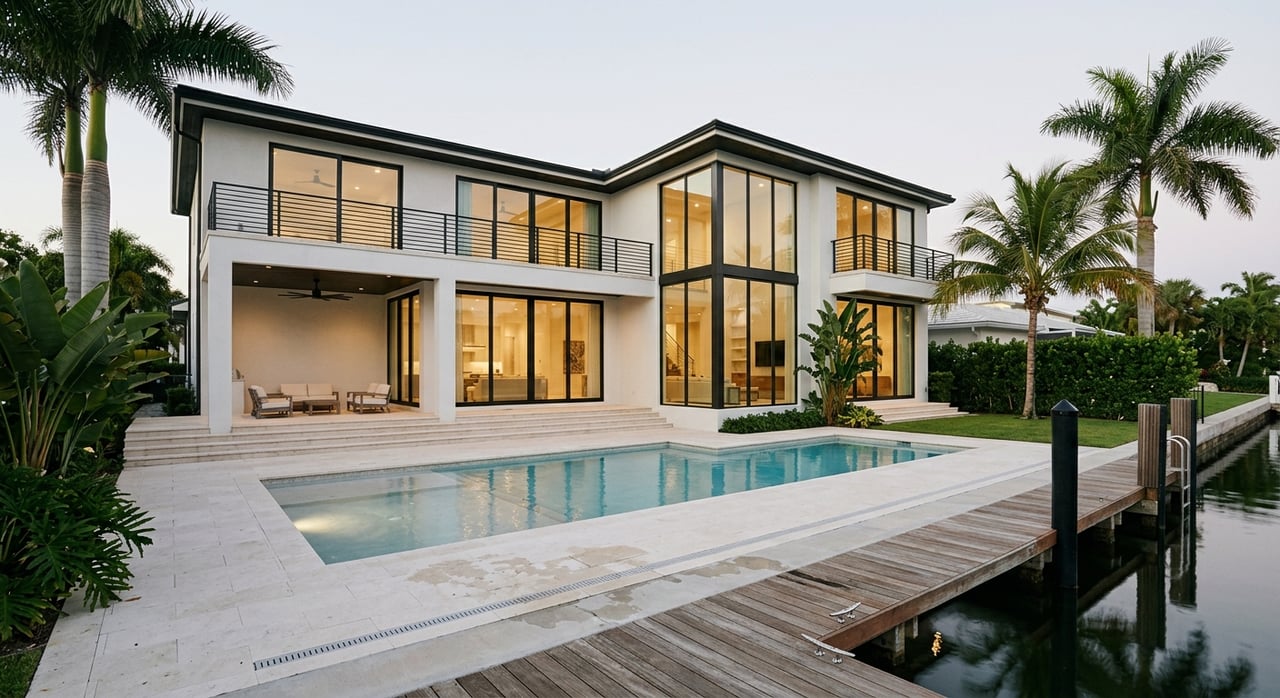
The Fort Lauderdale luxury market is not moving in one simple direction. If you are buying or selling at the high end, the biggest story right now is that single-family homes and condos are behaving very differently. That can make the market feel confusing, especially when headlines about South Florida do not always match what is happening block by block. In this guide, you will get a clearer picture of where Fort Lauderdale stands today, what is driving demand, and what that means for your next move. Let’s dive in.
Fort Lauderdale luxury in context
Fort Lauderdale remains one of Broward County’s core luxury markets. In 2025, Broward recorded 52 single-family sales at $10 million or more, and 36 of those sales were in Fort Lauderdale. That tells you Fort Lauderdale is not just part of the luxury conversation in South Florida. It is helping lead it.
The pricing thresholds also show how elevated this segment has become. In 2025, the single-family luxury threshold in Fort Lauderdale was $4.7 million, while the uber-luxury threshold was $10.3 million. Across Broward County, the single-family luxury threshold was $2.0 million and the uber-luxury threshold was $4.8 million, so Fort Lauderdale sits well above the county line.
That matters because it shows how different the city’s top tier is from the broader market. Fort Lauderdale’s 2025 citywide median sale price was $720,000 for single-family homes and $435,000 for condos. In other words, luxury here is a distinct market segment with its own pricing patterns, buyer pool, and pace.
Why Fort Lauderdale stands out
Fort Lauderdale offers a luxury entry point that is still more accessible than some nearby South Florida markets. Broward’s thresholds sit below Miami-Dade and Palm Beach, but they are still firmly in luxury territory. That creates an important middle ground for buyers who want coastal South Florida property without jumping immediately to the pricing often seen farther south or north.
At the same time, Fort Lauderdale has real depth. MIAMI Realtors identified it as one of Broward’s largest million-dollar markets, and among Broward markets with at least 15 luxury sales, Fort Lauderdale’s median million-dollar single-family sale price was $1.7 million in 2024. So while trophy sales grab attention, the market also includes a wide range of higher-end opportunities across waterfront homes, condos, townhomes, and newer construction.
Today’s biggest theme: a selective luxury market
If you only take one thing from today’s market, let it be this: luxury demand is still active, but it is selective. In March 2026, Broward’s total home sales rose 1.4% year over year, and sales of $1 million-plus properties climbed 7.4%. That is a useful signal because it shows higher-end demand holding up even while the broader market has become more mixed.
That does not mean every luxury property will sell quickly or at any price. It means buyers are still present, but they are paying close attention to property type, location, building condition, pricing, and long-term carrying costs. In a market like this, strong properties can still stand out, while overreaching listings can sit.
Single-family homes are tighter than condos
This is one of the clearest trends in Fort Lauderdale right now. In Q1 2026, the city had 838 active single-family listings with 6.9 months of supply. Condos had 1,548 active listings with 11.6 months of supply.
That gap matters for both buyers and sellers. In general, tighter single-family inventory can support stronger competition for well-located homes, especially in premium east-side and waterfront areas. Condos, by comparison, give buyers more choices and often more room to negotiate.
Countywide numbers show a similar pattern. As of March 2026, Broward had 4.8 months of supply for single-family homes and 11.3 months of supply for condos. Median time to contract was 44 days for single-family homes and 70 days for condos, reinforcing how much more inventory exists on the condo side.
East-side and waterfront areas play by different rules
Not all of Fort Lauderdale moves at the city average. Premium east-side ZIP codes show why many buyers and sellers feel the high-end market operates on its own track.
In 2025 annual data, Fort Lauderdale ZIP 33306 posted a $1.125 million median single-family sale price, and ZIP 33308 posted a $1.2 million median. In Q1 2025, ZIP 33316 reached a $2.5 million median single-family sale price. Those benchmarks help explain why waterfront and near-water homes often trade differently from the rest of the city.
For buyers, this means broad city data only tells part of the story. For sellers, it means pricing should reflect your specific location, product type, and buyer audience, not just a headline median number.
Condo buyers have more leverage, but more homework too
The condo side of the luxury market can offer opportunity, especially if you want choice and negotiating room. In premium Fort Lauderdale condo ZIP codes, inventory remains elevated. In Q1 2026, condo supply was 11.0 months in 33306 and 8.6 months in 33308.
That can create better conditions for buyers, but it also raises the importance of due diligence. Broward’s Building Safety Inspection Program outlines 25-year building safety inspections followed by 10-year intervals, and Florida law requires structural integrity reserve studies for many older condo buildings. These rules can affect monthly costs, reserve funding, buyer confidence, and resale appeal.
For sellers, that means finishes and views are only part of the equation. Buyers may also weigh building condition, reserve posture, and financing considerations before deciding how aggressive they want to be.
What is driving high-end demand
Several forces continue to support Fort Lauderdale luxury demand. One is migration into Broward County. In 2025, out-of-state driver-license exchanges in Broward rose 6%, led by people coming from New York, California, and New Jersey.
Cash is another major factor. In January 2026, Broward’s million-dollar single-family market was 43% cash, and the county’s million-dollar condo and townhome market was 71% cash. That helps explain why many luxury transactions can move differently from the broader market, where financing shifts may have a bigger impact.
New construction also remains important, especially for the condo segment. Over the 18 months ending in July 2025, international buyers purchased 49% of new South Florida construction, pre-construction, and condo-conversion sales. That sustained interest continues to shape demand for newer product across the region.
How Fort Lauderdale compares nearby
Fort Lauderdale does not exist in isolation. It is part of a broader luxury corridor across Broward, alongside markets such as Lighthouse Point, Pompano Beach, Weston, Davie, Hollywood, and Parkland. That wider geography gives buyers alternatives and gives sellers more competition than they may realize.
Compared with Miami-Dade and Palm Beach, Broward still offers a more accessible luxury starting point. As of January 2026, million-dollar sales made up 22% of Broward single-family sales, compared with 30% in Miami-Dade and 35% in Palm Beach. For many buyers, that makes Fort Lauderdale appealing because it delivers South Florida coastal access and prestige while still offering more pricing flexibility at the entry point.
At the very top end, nearby coastal pockets can still be even more extreme. Hillsboro Beach led Broward as the top uber-luxury market in 2025, while Fort Lauderdale had the county’s highest number of $10 million-plus sales. That tells you Fort Lauderdale is both deep and broad, with a strong share of elite transactions but also a wider mix of luxury inventory.
What buyers should keep in mind
If you are shopping in Fort Lauderdale luxury today, it helps to approach the market by property category rather than by citywide averages. A waterfront single-family home, a newer condo, and an older condo tower may all sit within the same broader luxury market, but they do not offer the same leverage or risk profile.
A smart buyer focus includes:
- Comparing single-family and condo inventory separately
- Watching east-side and waterfront pricing more closely than citywide medians
- Looking beyond asking price to building condition and reserves in condos
- Understanding that cash-heavy competition can still shape desirable listings
- Comparing Fort Lauderdale with nearby Broward coastal options when weighing value
In a selective market, the right property can still move fast. The key is knowing where supply is tight, where leverage exists, and what trade-offs come with each option.
What sellers should keep in mind
If you are selling, strategy matters more than ever. A well-located single-family property may benefit from tighter supply, but buyers at this level still expect pricing discipline and polished presentation. A condo seller may need to be even more precise, especially if similar inventory is stacking up nearby.
A smart seller focus includes:
- Pricing from current competing inventory, not just past peak headlines
- Understanding how your submarket differs from the city at large
- Preparing for buyer questions about building condition and reserves in condos
- Presenting the property clearly and professionally from day one
- Recognizing that luxury buyers are selective, informed, and often comparing multiple areas
In this market, confidence comes from preparation. When a property is positioned correctly, it has a much better chance to attract the right buyer without unnecessary delay.
Why local guidance matters here
Fort Lauderdale luxury real estate is intensely local. The spread between a broad city median and a prime waterfront sale can be enormous, and the difference between single-family and condo conditions is too significant to ignore. That is why buyers and sellers benefit from advice grounded in Fort Lauderdale’s actual neighborhoods, inventory patterns, and pricing tiers.
Tim Singer South Florida is built around that local focus. With decades in the Fort Lauderdale market, deep experience in luxury residential sales, waterfront homes, condos, townhomes, new construction, relocation, and investment-minded purchases, the team brings the kind of practical judgment that helps clients make clear decisions in a market that is anything but one-size-fits-all.
If you are thinking about buying, selling, or simply trying to understand how your property fits into today’s Fort Lauderdale luxury market, connect with Tim Singer for knowledgeable, local guidance.
FAQs
What counts as a luxury home in Fort Lauderdale today?
- In 2025, the single-family luxury threshold in Fort Lauderdale was $4.7 million, and the uber-luxury threshold was $10.3 million.
Is the Fort Lauderdale luxury market stronger for houses or condos?
- Current data points to tighter conditions for single-family homes and more supply on the condo side, which generally gives condo buyers more leverage.
Are Fort Lauderdale condos slower to sell right now?
- Broward County data from March 2026 showed a median time to contract of 70 days for condos versus 44 days for single-family homes, which suggests condos are moving more slowly overall.
Why do Fort Lauderdale waterfront homes seem different from the rest of the market?
- Premium east-side and near-water areas post much higher median sale prices than the city as a whole, so those homes often follow their own pricing and demand patterns.
What should Fort Lauderdale condo buyers review before making an offer?
- Buyers should closely review building condition, reserve funding, and inspection-related requirements because these factors can affect ownership costs and resale appeal.
Is Fort Lauderdale still more accessible than Miami or Palm Beach for luxury buyers?
- Yes. Broward’s luxury entry thresholds remain below those in Miami-Dade and Palm Beach, even though Fort Lauderdale is still firmly a high-end South Florida market.