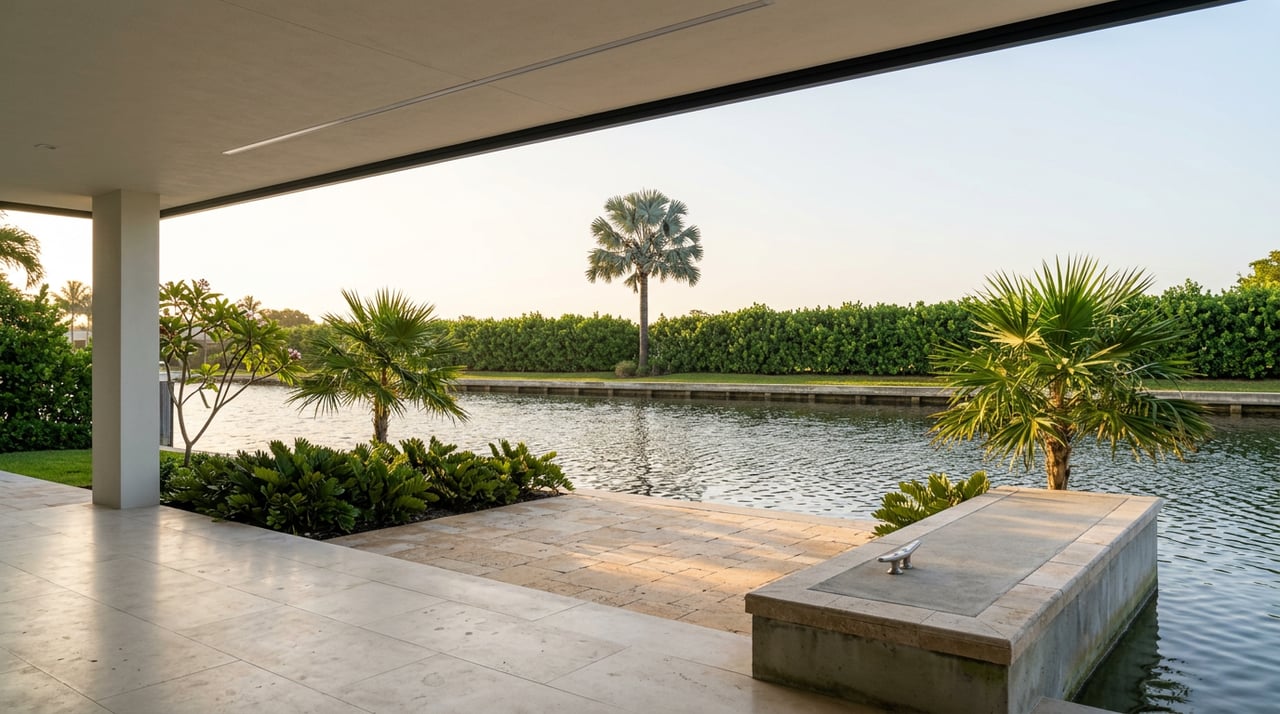
A listing on the south side of Las Olas Isles recently described itself this way: new floors, new paint, and a new seawall, dock, and pool. In this neighborhood, "new seawall" can refer to different projects funded by different parties, so buyers should confirm which work was done and who paid for it.
Here is the distinction that matters. The City of Fort Lauderdale has spent the last several years replacing its own seawalls along Las Olas Boulevard, SE 10th Street, and Hendricks Isle, using corrosion-resistant steel sheet piles and raising the cap elevation to guard against tidal flooding. That work, a roughly $2.95 million contract with Poseidon Dredge & Marine covering about 790 linear feet, plus a separate $1.5 million project on Hendricks Isle with Ebsary Foundation Company replacing two walls over 50 years old, is public infrastructure. It protects the road and the public right of way. It does not touch the private seawall behind an individual home, the one holding back the water at the edge of that home's own pool deck and dock.
And on these finger canals, it wears out faster than almost anywhere else in the city. The saltwater in a narrow, dead-end canal doesn't flush the way it does on the open Intracoastal, which accelerates rebar corrosion in concrete seawalls. Marine contractors who work these waterways specifically flag the New River corridor and Las Olas Isles as the pockets seeing the most accelerated wear. Replacement isn't cheap: published per-linear-foot estimates for new seawall systems in South Florida run roughly $175 to $400, before accounting for water depth, access, and demolition of the old wall, and full replacements on a compromised property can run well past $100,000. A standard home inspection typically doesn't include a seawall evaluation at all.
So when a listing says "new seawall," the question worth asking isn't whether it's new. It's whose money built it, and whether that has anything to do with the wall actually protecting the house.
A Median Built on Five Sales
Price data also needs context, particularly in a small market.
In January 2026, Redfin reported the median sale price in Las Olas Isles at $4.0 million, up 12.8% from a year earlier. In the same report, covering the same month, the median price per square foot was $902, down 36.6% from a year earlier. Those two numbers point in different directions, so neither alone shows how values for comparable homes changed. A rising median price alongside a falling price per square foot can reflect a change in the mix of homes that happened to sell; it does not establish that value per square foot for comparable homes collapsed by more than a third in twelve months.
The explanation is in the volume. Five homes sold in Las Olas Isles that January, down from six the year before. Days on market nearly doubled over the same span, from 100 to 218. A median built from five transactions isn't a trend line. It's closer to five individual outcomes standing in for an entire neighborhood, where one oversized new-construction estate, or one raw teardown lot priced for its land rather than its square footage, can swing the average by tens of percentage points in either direction.
The instability doesn't stop at that one report. By March 2026, a different data source, Movoto, put the median list price at $6.99 million, with days on market at 155. By August 2026, another aggregator had it at just under $8 million, compared with roughly $4.9 million the August before. Three snapshots, three different months, two different measures (list price versus sold price), and three numbers that don't reconcile with each other. That isn't a sign anyone made an error. It's what happens when a headline statistic is asked to summarize a market where single-digit monthly sales counts are normal.
For a buyer comparing neighborhoods, the practical takeaway isn't which of these numbers is "right." It's that none of them, on their own, tells you what a specific house on a specific street is worth. In a market this thin, the median is a description of whoever happened to close that month, not a forecast of what the next closing will look like.
A Network Wearing One Name
Part of why the aggregate number is so noisy is that "Las Olas Isles" isn't really one neighborhood. It's a name applied to a network of man-made islands. The canals were dredged in the 1920s and modeled on Venice, and the distinct areas have their own character and price tiers.
| Sub-island | What sets it apart |
|---|---|
| Seven Isles | Guard-gated, the most exclusive of the group |
| Idlewyld | Known for mega-yacht-friendly, deep-water lots |
| Nurmi Isles | Broader mix of property types, including condos and townhomes |
| Hendricks Isle | Falls within Nurmi Isles; recent site of the city's public seawall replacement |
| Isle of Venice | Also within Nurmi Isles; similarly mixed housing stock |
| Riviera Isles | Waterfront single-family homes along the canal network |
| Las Olas Isles proper | The original core islands closest to the boulevard |
A single blended median for "Las Olas Isles" is averaging a guard-gated island built for superyachts against a more mixed pocket that includes townhomes and condos. That's not a flaw in the reporting. It's a reminder that the search term and the market aren't the same thing, and a buyer who wants a real comparison needs to ask which island, not just which zip code.
What Actually Answers the Question a Median Can't
None of this means the neighborhood's data is meaningless. It means the aggregate number is a starting point, not a conclusion. Two questions do more real work than the median ever will.
First, ask when the private seawall was last replaced, by whom, and whether the work included a new engineering assessment, not just a cosmetic cap repair. On the New River and Intracoastal side of any property, it is worth checking the permit record rather than taking the work on faith.
Second, ask for comparable sales on the same island, ideally the same street, rather than a blended neighborhood average. With Las Olas Isles selling in single digits most months, a "comp" from a different sub-island, a different dock configuration, or a different bridge clearance to open water isn't really comparable at all.
A Few Direct Questions
Does the city's seawall project cover my private seawall too? No. The city's recent work along Las Olas Boulevard, SE 10th Street, and Hendricks Isle replaced public, city-owned bulkhead. The seawall behind an individual home, protecting that home's own pool deck and dock, is separate from that public work.
How long does a seawall in this neighborhood typically last? Contractors working these canals generally cite a 30 to 50 year lifespan, shorter on finger canals where saltwater doesn't circulate well, which is part of why Las Olas Isles shows up repeatedly as one of the faster-deteriorating pockets in the city.
Why do the median price and price per square foot sometimes move in opposite directions? Because the sample size is small enough that the mix of homes selling in any given month can move the medians without showing how values for comparable homes changed. A market moving five or six sales a month is not one where a single median can be trusted as a trend.
If you're comparing Las Olas Isles against another Fort Lauderdale waterfront address, the number on the portal is a place to start the conversation, not a place to end it. Tim Singer has spent more than 35 years reading these blocks street by street, seawall by seawall, and can tell you what a specific address is actually carrying before you make an offer on it.
This article is general information, not legal, tax or financial advice. Consult a qualified professional about your situation.